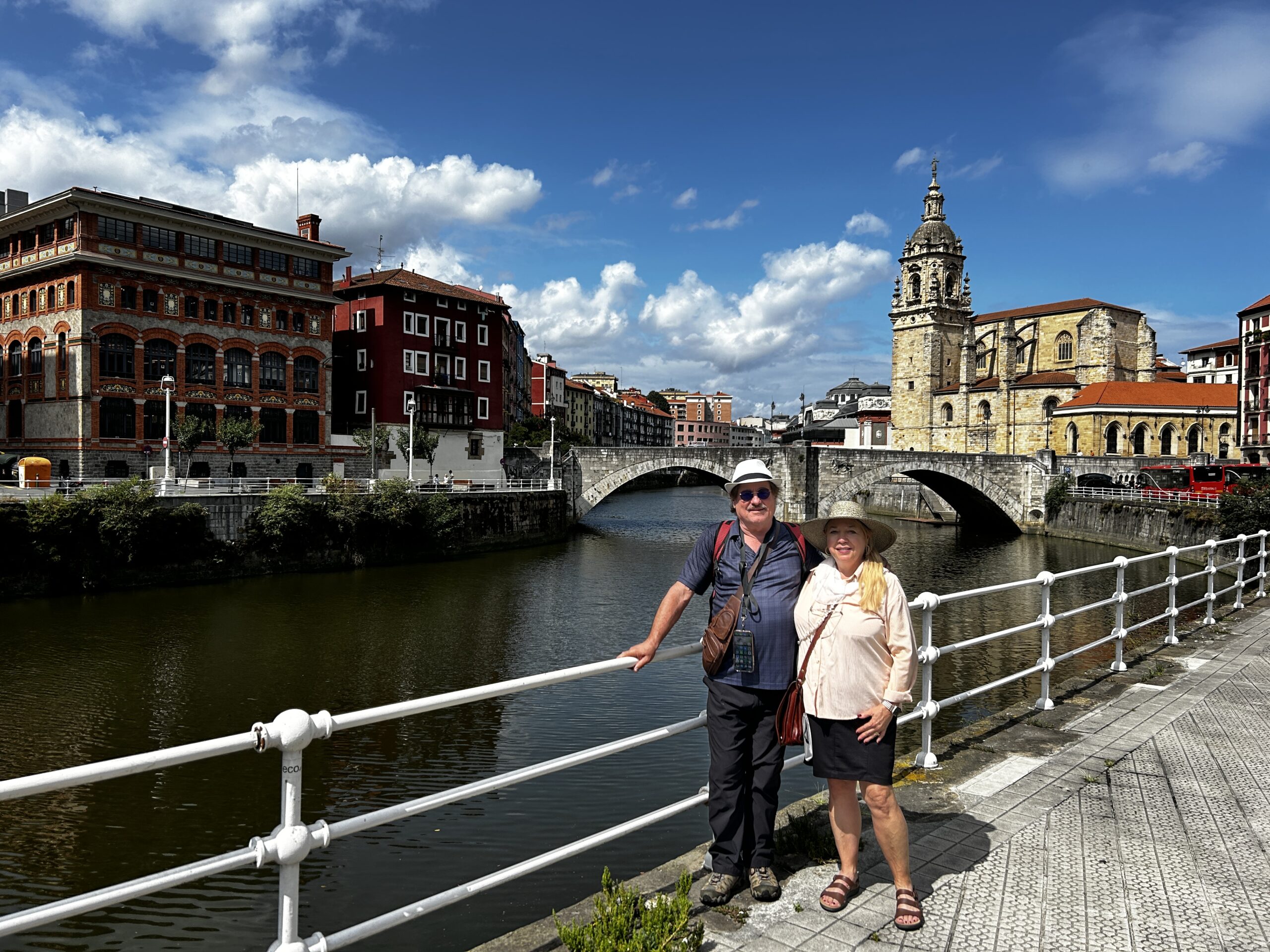
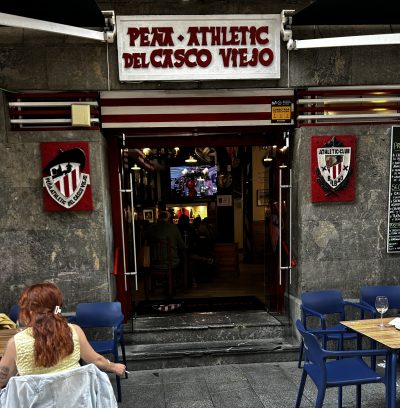
We ended our cruise in Bilbao. Great, beautiful city.
We arrived early in the morning like in London. We stayed at a Holiday Inn Express near the airport since we were flying to Amsterdam the next day. I think we got ripped off by the taxi driver from the ship to the hotel. The front desk clerk Alexander worked hard to quickly get us a room quickly.
It is the heart and western edge of Basque country. It is estimated that Basque culture has been around 40,000 years. Of all the ports we visited, I would love to come back and stay a few days in three of them: Brugges, Honfleur, and Bilbao. La Rochelle, Bordeaux, and Santander were enjoyable, but did not leave me with a huge desire to return. We couldn’t visit Port St. Peter due to rough seas.
Now, I know that I didn’t have much nice to say about Brest. But I have an update. We met a couple from South Carolina on the ship who told us they had a wonderful time in Brest. What did we miss?
I mentioned earlier that the ship shuttle dropped us off in the deserted downtown on Saturday morning. Unbeknownst to us, if you take a steep 25-minute walk down to the water, there are shops, restaurants, etc. The couple we met only learned about this by asking a local where to go. If that is the case, the issue I have then is, why didn’t the ship shuttle drop us off there? It sems that in every port, the shuttle could drop us off wherever they want. I felt sorry for the older people who would’ve had to walk down to the water, then climb back up to catch the shuttle back to the ship. Not a good move Oceania.
So Brest is probably fine if you go to the right place.
About Bilbao:
In the 2nd century, Bilbao was part of the Roman empire, the Romans really didn’t govern it much because of the mountainous terrain. Christian missionaries came to the region in the 3rd century to convert local tribes.
After the fall of the Western Roman Empire, the Basque region, including Bilbao, largely resisted the barbarian Visigoths, maintaining their language (Euskara) and culture.
The Muslims conquered most of Spain in 711, but it had little impact in the Basque region because of the hills. So the Basque country remained a Christian stronghold and a refuge for Christians fleeing the Muslims.
Bilbao became an official city in June 1300. The name “Bilbao” comes from the Basque words bil (hill) and bao (river). Like Santander, Bilbao became a stop for pilgrims walking the Camino de Santiago.
During the Spanish Civil War, Bilbao was anti-Franco (unlike Santander) and suffered heavy bombing. The city fell to Franco’s Nationalist forces in June 1937, leading to the repression of Basque culture under Franco’s dictatorship (1939–1975). Franco banned the Euskara language. Of course, that infuriated the Basque people.
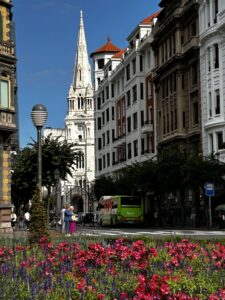
Bilbao is surrounded by lush green hills. I love northern Spain because it’s so green. Very similar to Ireland.
We took a foodie tour to get pinchos (not tapas). Miguel showed up as our guide wearing a Black Sabbath T-Shirt. We were the only two people on the tour: which be either a positive or negative experience. Several years ago, when we were in Seville, Spain, our tour guide showed up in a 12-person van with a driver. We were the only people on the tour. It was a great experience because we were given such special attention.
In my opinion, Miguel was not as good. He was of Basque heritage. And normal for a Basque in the sense that he did not see himself as Spanish. There were no Spanish flags flying around, only Basque flags. He explained how the independent Basques are autonomous; they teach their own language, run their own medical system, and don’t send money to Madrid like the rest of the regions in Spain.
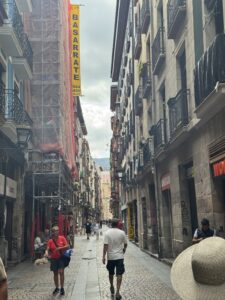
The tour was not as good as expected because we visited only two restaurants, he seemed in a hurry and bored at times, and he ended the tour an hour early. I’m sure he could have figured out how to spend more time with us. However, it was fun to walk around the Old Town of Bilbao on such a great weather day. Interesting observation in Europe: The restaurants, cafes, bars, etc. are continuously filled with people engaging in something new: Conversation. Hardly anyone in a group at a table was staring at their cell phone. People seem to like talking to each other. Maybe we should try it in the U.S.
Our biggest disappointment was the visit to St. James Cathedral—or should I say, lack of visit. When we attempted to enter the church to pray, the lady guarding the place wanted 10 euros per person to enter—even though there was a sign that said, “For those entering to pray, there is no charge.” She told us that the sign didn’t refer to RIGHT NOW. We were not happy. Took the bus back to the airport, and then the shuttle to the hotel.
.
2 thoughts on “Bilbao – Day 13 of 55”
What happened next??
I just added a few more posts.