What a difference a port makes. Here we are in Brest. Our ship is docked for only six hours. It is Saturday morning and raining. Our shuttle bus dropped us off downtown around 10:30 am. We got out of the shuttle and walked around a bit. The place was dead. Downtown streets empty. Nothing open. Nothing going on. If I fell over dead, and Rebecca wasn’t there, it would take at least an hour for someone to find me.
So, what did we do? We decided to walk 2½ miles in the drizzle and rain to an aquarium called “Oceanopolis.” We figured we needed to exercise. For most of the way, there was a busy street on one side and various fauna and flora on the other side, with some cliffs behind that. Rebecca told me about every tree, plant, grass, mold, fungus, and ground cover that we passed by. We made it to the aquarium despite discovering painful muscles around my left hip that I never knew existed.
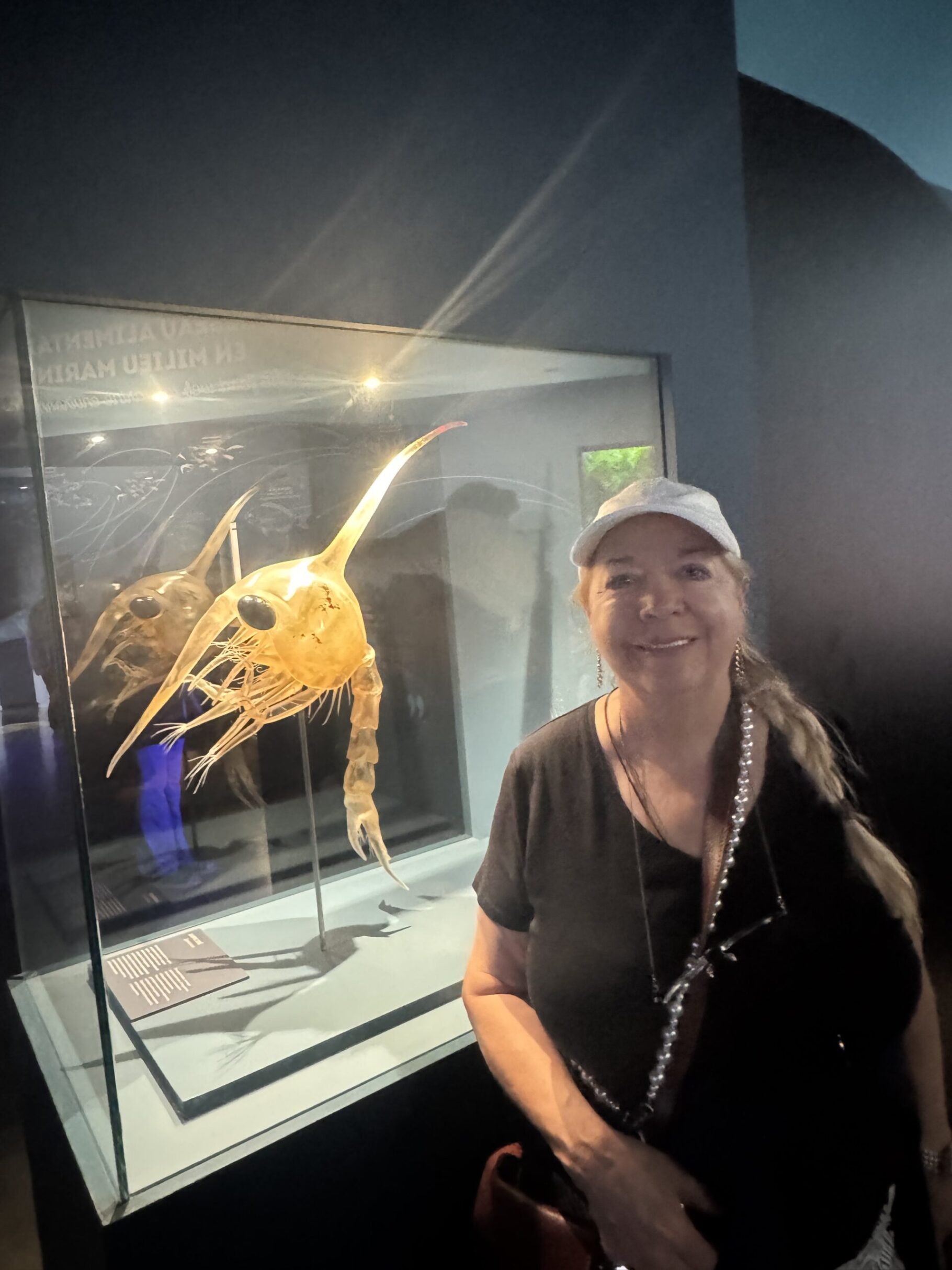
The aquarium wasn’t bad. Clearly it was better than staring at empty downtown streets. The place was dedicated to sea life along 1800 miles of French coastline in Brittany. There are a lot of colorful sea life critters in these waters. I imagine snorkeling would be good.
We watched a weird demonstration. We were in an auditorium looking at a huge screen. On the right side was a French lady standing in front of a huge fish tank. We put on our headsets to listen in English, and the narration began.
The movie starts; we watch the screen listening to a narrator talking about Marine life. At the same time, the French lady is down below in front of the fish tank is non-stop talking in the background. Since she’s talking in French, I couldn’t tell whether she is saying the same things we were hearing in our headsets, or whether was talking about something else. But she was talking fast. I will say that it was a bit annoying listening to English in headsets with her rambling in French in the background.
Every now and then the narrator pauses, and the big screen would show a hand in the sea moving around sea anemones, coral, mollusks, and other sea things. Then the narrator would start talking again. However, even during the pause, the French lady wouldn’t stop talking. It was about halfway through the film when I realized that, when the narrator paused and a hand went into the ocean to move the sea critters around, it was the French lady whose hand was being filmed in the aquarium. I felt stupid. But the French lady never stopped talking.
We walked the 2½ miles back to the downtown area and caught the bus back to the ship. On the bus, I heard a couple of other ladies complaining about how they couldn’t find any souvenir shops or stores or anything open. Just as I thought, there simply was nothing to do in Brest. Note to the future: If you ever stop in Brest again, don’t get off the ship! What a boring place.
When we arrived back at the ship, Rebecca convinced me to participate in a painting art class. Although the most recent painting I had done was with my fingers in kindergarten, I relented since she wanted us to do something together.
Surprisingly, it was enjoyable. Rebecca claims I did a good job. Not sure I believe her. I’ll post the picture when I get hold of it.
As we moved south down the coast of France, we moved from Honfleur in the region of Normandy to Brest in the region of Brittany.
Quick History: Christianity began to appear in Brest in the late 4th and early 5th centuries as missionaries arrived from Britain and Ireland. By the Middle Ages, monasteries (primarily Benedictine) were built. Around the 11th and 12th centuries, stone churches were built. One of the earliest was the 18th-century church of Saint-Louis.
Brest has a natural harbor and therefore is a key strategic port, which became both a blessing and a curse. The British and French battled for control of Brest until 1534, when Brittany was officially incorporated as a province of France. The French then developed Brest into a strategic naval base critical for shipbuilding and military operations, especially during the Napoleonic Wars (1803–1815). That’s when Napoleon fought several countries in Europe.
Like the rest of France, during the French Revolution (1789-1799), most churches and monasteries were destroyed, religious properties were confiscated, and clergy were forced to swear loyalty to the government. Under Napoleon, the Concordat of 1801 allowed churches in Brest to reopen or be rebuilt. The city continued to be developed into a major shipbuilding and naval center.
During World War I, the U.S. Navy established a naval base in Brest to counter German submarines. The port became a major arrival point for over 700,000 American troops. During World War II, Nazi’s occupied Brest and turned it into a major U-boat base. In 1944, after the Normandy invasion, Allied bombs demolished the city—about 80% of its buildings were destroyed to retake the port and destroy the submarine base.
The history was more interesting than actually being here.
1 thought on “Brest – Day 8 of 55”
Where is the picture???